
What Is Invoice Factoring? How It Works and Why Businesses Use It
You finished the job, delivered the order, and sent the invoice. Now you’re waiting 30, 60, or even 90 days to get paid, while payroll, materials, other bills, and rent are due right now.
That gap between invoicing and getting paid is one of the most common cash flow problems for B2B companies. Invoice factoring is one way to close it.
What Is Invoice Factoring?
Invoice factoring, sometimes called accounts receivable financing, lets you sell your unpaid invoices to a factoring company in exchange for immediate cash. Instead of waiting for your customer to pay, you receive an advance on the invoice value up front. When your customer pays, the remaining balance is released to you, minus the agreed-upon fees.
It’s not a traditional loan. Approval leans heavily on the quality of your invoices and the payment history of your customers, rather than only your own credit or time in business.
How Invoice Factoring Works
The process is simpler than most business owners expect:
- Invoice your customer as you normally would.
- Submit the invoice to your factoring partner.
- Receive your advance, a percentage of the invoice value.
- Your customer pays according to the invoice terms.
- Receive the remaining balance, less the factoring fee.
5 Signs Invoice Factoring May Be a Good Fit
1. You’re waiting on slow-paying customers. If net-30, net-60, or net-90 terms are straining your cash, factoring turns that wait into working capital.
2. You’re growing faster than your cash flow. Growth is expensive. Factoring scales with your sales, so the more you invoice, the more funding is available.
3. You’ve been turned down for a bank loan. Banks often require strong credit, deep financials, and long approval timelines. Factoring is built around your receivables, which can make it more accessible.
4. You want to take on larger orders. If a big contract means buying materials or hiring labor up front, factoring can help you say yes.
5. You’d rather not chase payments. Some factoring arrangements include collections support, giving you time back to run your business.
Who Uses Invoice Factoring?
Businesses that invoice other businesses or government agencies use it most, including manufacturers, staffing agencies, construction & trades, distributors, wholesalers, and service providers with long payment cycles.
Invoice Factoring vs. a Bank Loan
Bank loans can carry lower rates, but they can also mean heavy paperwork and a long wait. Factoring is tied to your receivables and is typically faster to put in place. Neither option is automatically better. The right choice depends on your margins, your customers, and how quickly you need the cash.
Questions to Ask Before You Factor
Factoring costs vary, and not every provider is upfront about them. Before you sign, ask:
- What is the advance rate, and what is the total fee structure?
- Are there minimums, setup fees, or termination fees?
- Is the arrangement recourse or non-recourse, and what does that mean for me?
- Will my customers be notified?
- How quickly will I be funded?
Invoice Factoring Through EFS
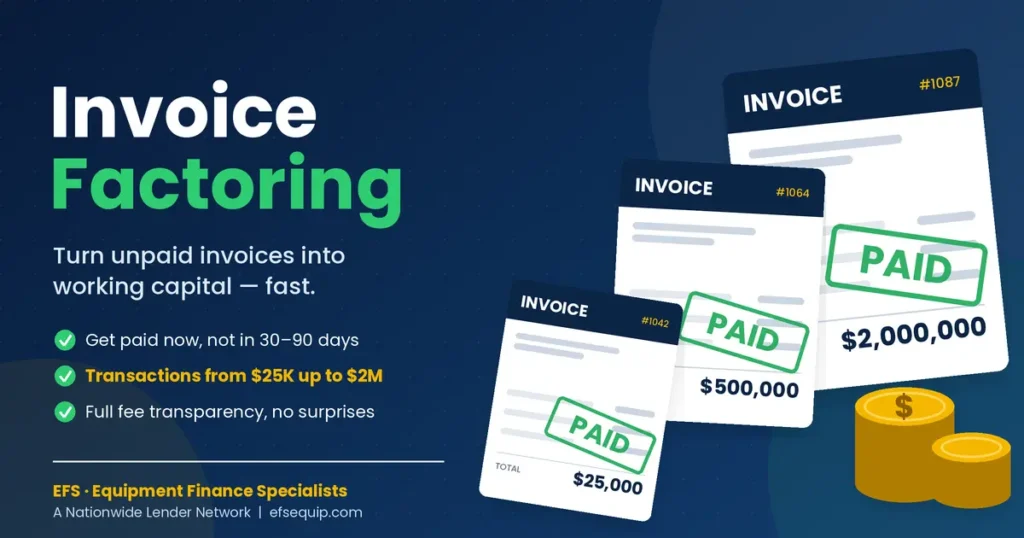
At Equipment Finance Specialists, we now offer invoice factoring from $25K up to $2M per transaction to give our clients a wider range of finance options.
We run our business on honesty, integrity, and transparency. That means full disclosure of every fee and every term before you commit, something many of our clients tell us they didn’t get elsewhere. As an independent broker with access to a Nationwide Lender Network, we work closely with our lenders to find the best options for your needs.
Ready to Turn Your Invoices Into Cash?
Don’t let unpaid invoices hold your business back. Contact Equipment Finance Specialists today for a free, no-obligation consultation by clicking the Call button below or click here for our Invoice Factoring page, and find out how invoice factoring can improve your cash flow.